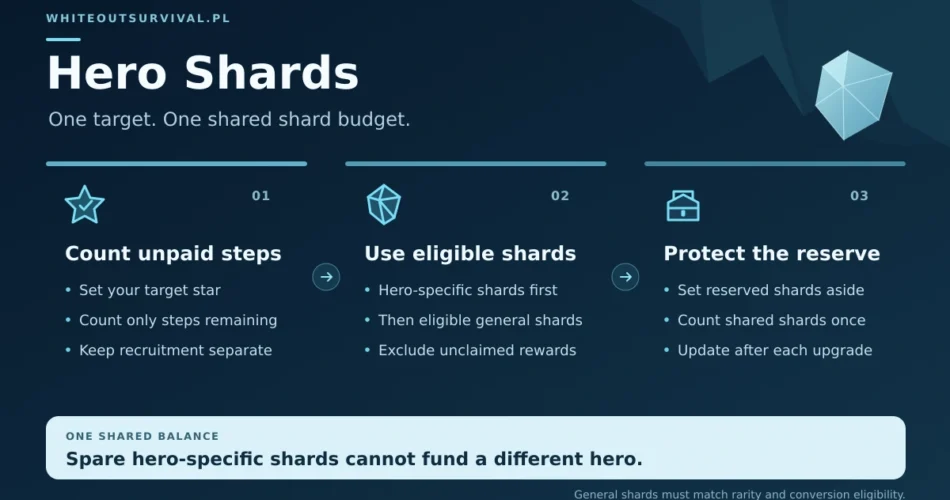
A hero needs 300 shards to go from a completed three stars to four stars, then another 600 to reach five stars. If you have already completed part of that next star, your remaining cost is lower. Start with that remaining cost before deciding how many general shards to convert.
This guide gives you a way to budget one upgrade, compare two heroes and keep the same general shards from appearing in both plans. Use the hero directory to look up the hero you are building as you work through the examples.
Separate recruitment, stars and skills
Recruiting a locked hero and promoting a hero you already own are separate costs. The table below starts after recruitment. If the hero is still locked, add its recruitment requirement separately.
Hero XP raises a hero’s level. Shards advance its stars, while skill development also needs the appropriate manuals. Before spending, write down the job you want the hero to do and the specific improvement you are buying. “Reach four stars for my main march” is a clearer target than “make this hero stronger.”
For a rally plan, decide whether you are leading or joining. A rally leader’s squad and a joining squad contribute skills differently. Budget for the role you actually play rather than choosing an upgrade solely from the hero’s total power.
Hero shard costs by completed star
Each row is the cost of finishing the next full star from the previous completed star. The last column adds the promotion costs from a newly recruited, zero-star hero; it excludes recruitment.
| Upgrade | Six step costs | Cost of this star | Total since recruitment |
|---|---|---|---|
| 0 to 1 star | 1, 1, 2, 2, 2, 2 | 10 | 10 |
| 1 to 2 stars | 5, 5, 5, 5, 5, 15 | 40 | 50 |
| 2 to 3 stars | 15, 15, 15, 15, 15, 40 | 115 | 165 |
| 3 to 4 stars | 40, 40, 40, 40, 40, 100 | 300 | 465 |
| 4 to 5 stars | 100, 100, 100, 100, 100, 100 | 600 | 1,065 |
The final step into four stars costs 100 shards. That is why a nearly filled star can still leave a substantial gap. Count the steps you have already completed instead of estimating the cost from how full the star looks.
Calculate a partly completed star
Add only the steps still ahead of you. For a target several stars away, add the unfinished part of your current star and the full cost of every later star you want to complete.
- Three stars, two steps completed toward four: 40 + 40 + 40 + 100 = 220 shards remain.
- Three stars, five steps completed toward four: the final step costs 100 shards.
- Four stars, two steps completed toward five: four steps of 100 remain, so the cost is 400.
- Two completed stars to four completed stars: 115 + 300 = 415 shards.
For these examples, “two steps completed” means you have already paid for the first two steps after the named whole star. It does not mean you are about to buy the second step.
Turn the remaining cost into an inventory plan
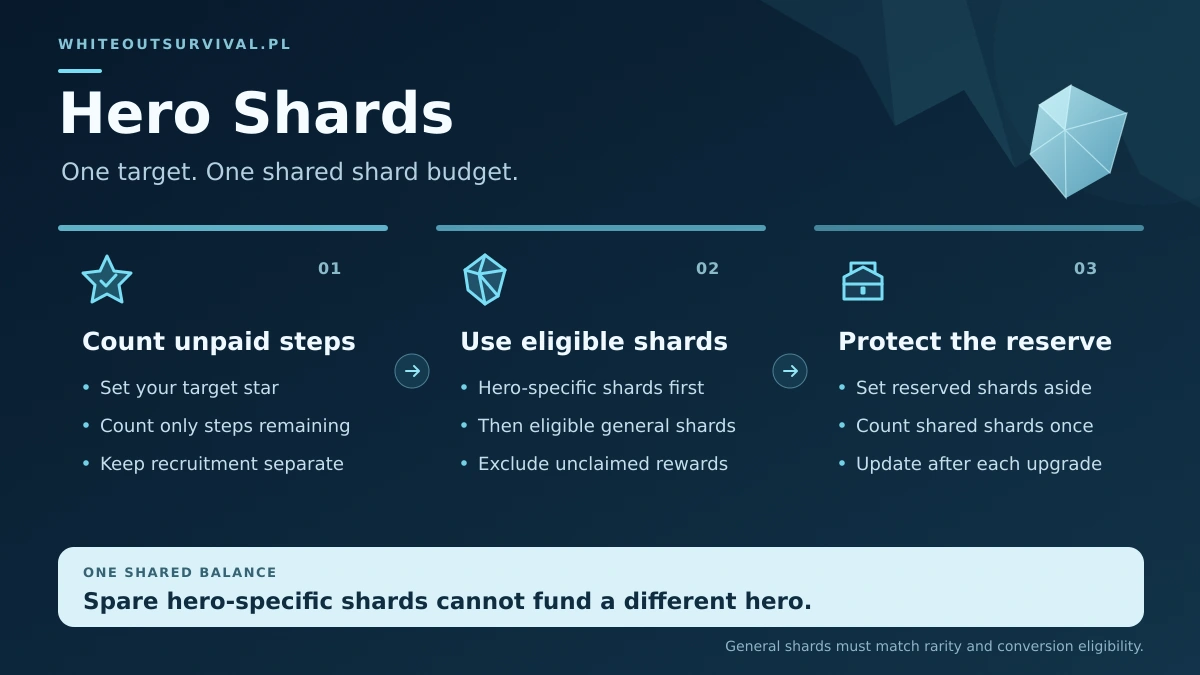
Keep hero-specific shards and general shards in separate columns. Hero-specific shards belong to that hero; eligible general shards are a shared budget across your roster.
General shards needed = remaining promotion cost minus usable hero-specific shards already owned. If the result is below zero, record zero. Then subtract any general shards you have reserved for another hero from your available balance.
Here is a worked example with invented inventory amounts:
| Budget item | Shards |
|---|---|
| Remaining promotion cost | 220 |
| Hero-specific shards owned | 80 |
| General shards needed | 140 |
| Unreserved general shards owned | 200 |
| General shards left after this plan | 60 |
This plan is funded. Convert the 140 needed for the target rather than automatically converting all 200. The remaining 60 stay available for another eligible hero.
If you expect 50 more hero-specific shards from an upcoming event, keep them in a separate forecast. The plan needs 140 general shards today; it would need 90 after those 50 shards are actually collected. Keeping those two versions separate avoids spending against rewards you do not yet own.
Compare two heroes without counting shards twice
Suppose both heroes below can use the same general-shard type, and you have 200 unreserved general shards:
| Target | Remaining cost | Specific shards owned | General shards needed |
|---|---|---|---|
| Hero A reaches four stars | 220 | 80 | 140 |
| Hero B reaches four stars | 300 | 180 | 120 |
| Both targets | 520 | 260 | 260 |
Calculate each hero’s general-shard need separately, with a minimum of zero, then add those needs. Extra specific shards for Hero A cannot cover Hero B’s shortage.
Either target fits the 200-shard balance on its own. Together they leave a 60-shard shortage. Choosing A leaves 60 general shards; choosing B leaves 80. Those leftovers do not finish the other target.
Pick the target that solves the more important problem in your roster. Write that problem next to the hero: a frontline replacement, a hero used in several marches, or an alliance-requested support role. A lower shard bill is useful, but it does not establish which hero will help your account more.
Four stars or five stars?
The next star becomes much more expensive after four. A budget of 600 promotion shards can fund either:
- One hero from four completed stars to five
- Two heroes from three completed stars to four, at 300 each
That is a cost comparison, not a claim that the two results have equal combat value. It also assumes the shards can be allocated to those heroes. A stockpile of one hero’s specific shards cannot be split between two different heroes.
Before committing to the fifth star, compare the next upgrade on the hero you use most with the unfinished targets elsewhere in your roster. Look at the relevant skill, current equipment and intended mode together. For Arena choices, use the Arena guide and its generation guides; the shard bill alone cannot choose a formation.
Keep the shard types straight
General shards must match the hero’s rarity and conversion eligibility. You need to own the hero before using general shards for it. Natalia and Jeronimo require their own hero-specific shards, so do not include your general-shard balance in their upgrade budgets.
Record the exact item you own. A chest you have not opened, a hero-specific shard and a general shard should not all appear as an interchangeable number under “shards.” Keep unclaimed or random rewards outside the funded version of your plan.
Your pre-upgrade checklist
- Name the hero, intended role and target star.
- Record its current whole stars and completed steps.
- Add the remaining step costs, excluding recruitment if the hero is already owned.
- Subtract the usable hero-specific shards in your inventory.
- Allocate eligible general shards from one shared balance.
- Keep expected rewards separate from shards already owned.
- Record any skill manuals needed for the improvement you want.
- After upgrading, update the remaining general-shard balance before planning another hero.
A useful shard plan ends with three numbers: the cost still ahead, the general shards you will commit and the balance you will keep. Once those are clear, you can compare targets without relying on a misleading total in your backpack.

